If you've ever mentioned your interest in astrology at a dinner party, you've probably encountered *that* person. You know the one — they cross their arms, smirk, and say, "You know that's not real science, right?" It's a frustrating moment, especially when you've experienced genuine insights through your birth chart or daily horoscope. Here's the thing: comparing astrology to science is like comparing poetry to mathematics. They're different languages for understanding our human experience, and both have their place.
Let's dive into this conversation together and explore what makes these two systems different, where they overlap, and why you don't have to choose one over the other.
The Scientific Method: What Makes Something "Science"
Before we can compare astrology to science, we need to understand what science actually is. At its core, science is a method — a specific way of investigating the world through observation, hypothesis, experimentation, and replication.
For something to be considered scientifically valid, it needs to be testable and falsifiable. This means researchers must be able to design experiments that could potentially prove the theory wrong. When multiple independent studies reach the same conclusions, we start building scientific consensus.
Science excels at answering "how" questions. How do the stars form? How does gravity work? How do our brains process information? It's an incredible tool for understanding the physical mechanics of our universe.
But here's what science struggles with: the deeply personal, subjective, and meaning-based aspects of human existence. Science can tell you the chemical composition of a sunset, but it can't capture why that sunset makes you feel connected to something greater than yourself.
Astrology as a Symbolic Language of Meaning
Now let's talk about what astrology actually is — and what it isn't trying to be. Astrology is an ancient symbolic system that interprets the positions of celestial bodies to derive meaning about human experience, personality, and life cycles.
When you read your birth chart, you're not looking at a scientific document. You're engaging with a rich symbolic language that's been developed over thousands of years. Your Sun sign represents your core identity, your Moon sign reflects your emotional landscape, and your rising sign shows how you present yourself to the world.
Astrology answers "why" and "what does it mean" questions. Why do I feel so drawn to creative pursuits? What does this challenging period in my life mean for my growth? Why do I clash with certain personality types?
The stars in your natal chart don't cause your personality any more than a clock causes time to pass. Instead, astrology operates on the principle of "as above, so below" — the idea that patterns in the cosmos reflect patterns in human experience. It's a tool for reflection, self-understanding, and finding meaning.
Where Science and Astrology Actually Disagree
Let's be honest about the genuine tensions between these two systems. Scientific studies have repeatedly failed to find statistical evidence that planetary positions at birth influence personality traits or predict future events.
When researchers have tested whether people can identify their own horoscope among several options at rates better than chance, the results have been underwhelming. From a strict scientific standpoint, the mechanisms proposed by astrology don't align with our understanding of physics.
This is where many people get stuck. They feel they must either reject astrology entirely because science can't validate it, or reject science because their astrological experiences feel meaningful.
But this is a false choice. The real question isn't "Is astrology scientifically accurate?" The better question is "Is scientific accuracy the only valid measure of value?"
The Value of Symbolic and Intuitive Practices
Here's where things get interesting for those of us who embrace both rational thinking and spiritual practices. Humans have always used symbolic systems to navigate life's complexities.
Think about tarot cards. No one claims that randomly drawn cards have magical knowledge of your future. Yet millions of people find genuine insight through tarot readings. How? Because the cards serve as a mirror, prompting reflection and helping us access intuitive knowledge we already possess.
Astrology works similarly. When you read that Mercury retrograde might cause communication challenges, you become more mindful of your words and more patient with misunderstandings. Is that the stars influencing you, or is it the power of intentional awareness?
The birth chart functions as a comprehensive psychological and spiritual framework. It gives us language to discuss complex aspects of ourselves. It validates our struggles and celebrates our gifts. It connects us to cycles larger than our individual lives.
These benefits don't require scientific proof to be real and valuable.
Finding Your Own Balance Between Cosmic Wisdom and Scientific Understanding
So how do we hold both of these ways of knowing without cognitive dissonance? Here's what works for many spiritually-minded people who also respect scientific inquiry.
First, appreciate science for what it does brilliantly. Modern medicine, technology, and our understanding of the physical universe are genuine marvels. When you're sick, see a doctor. When you want to understand climate change, trust the researchers.
Second, appreciate astrology for what it offers uniquely. Use your horoscope as a tool for reflection, not prediction. Let your birth chart spark conversations about your patterns and potential. Allow the cosmic perspective to remind you that you're part of something vast and mysterious.
Third, stay curious and humble about what we don't know. Science itself acknowledges its limitations. Consciousness, the nature of time, the origins of the universe — these remain profound mysteries. Leaving room for wonder doesn't make you anti-science; it makes you intellectually honest.
Finally, trust your experience. If astrology has helped you understand yourself better, navigate difficult periods, or feel more connected to the rhythms of life, that's meaningful regardless of what any study says.
Why This Debate Matters Less Than You Think
At the end of the day, the astrology versus science debate often generates more heat than light. Most astrologers aren't trying to replace scientific understanding — they're offering a complementary lens for making sense of the human journey.
You can absolutely geek out over NASA discoveries and also find profound meaning in your Saturn return. You can appreciate evidence-based medicine and also use your birth chart for personal growth. You can think critically and still feel connected to the stars.
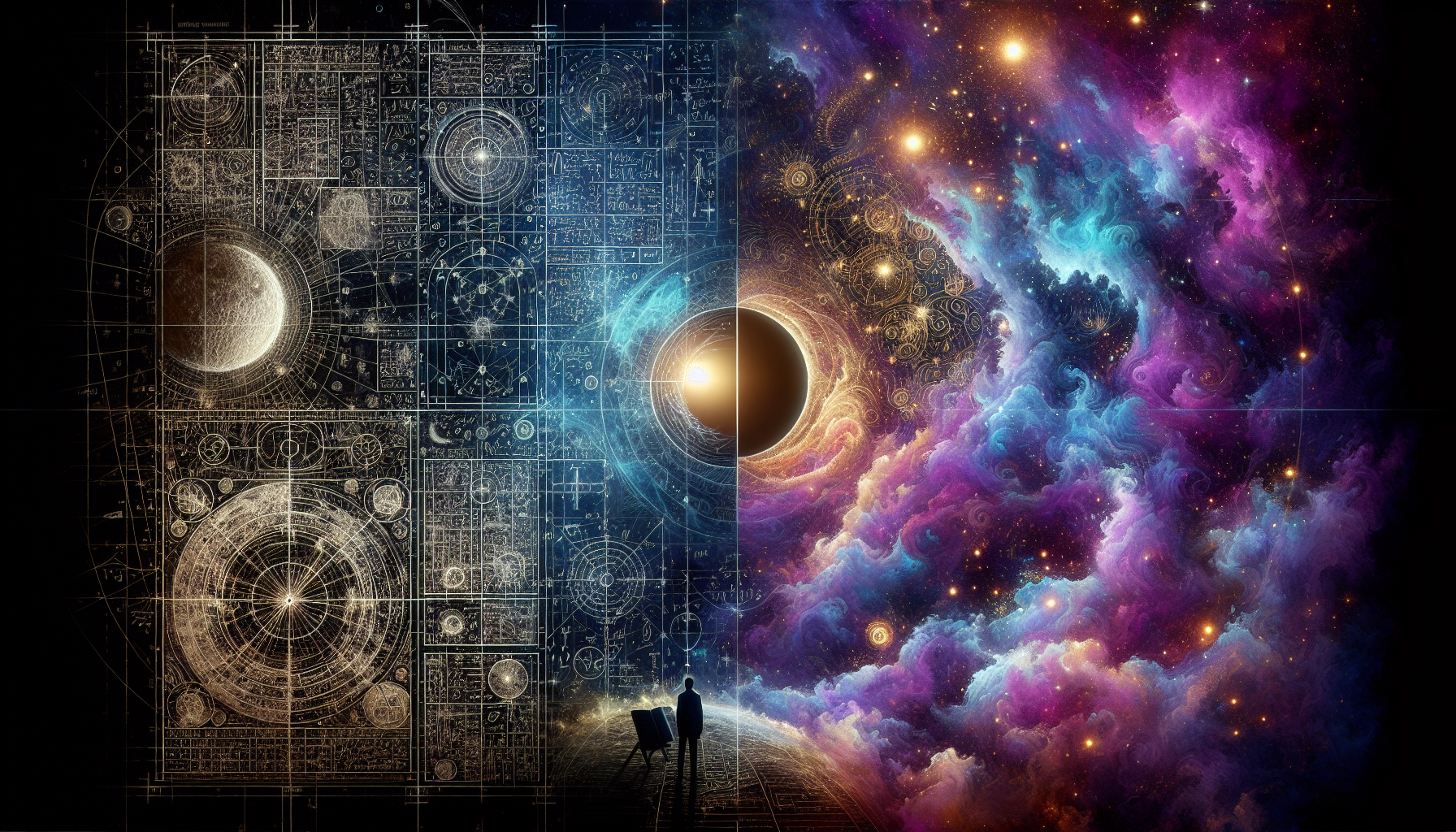
The universe is vast enough to hold multiple ways of knowing. Science maps the territory. Astrology helps us find meaning in the journey.
Ready to Explore What the Stars Reveal About You?
If you've been curious about astrology but hesitant because of the science question, consider this your permission slip. Approach your birth chart as a tool for self-reflection rather than a scientific document. Use your horoscope as a prompt for mindfulness rather than a fortune-telling device.
Start by pulling up your natal chart and sitting with what resonates. Notice what sparks recognition, what challenges you, and what opens new questions about who you are and who you're becoming.
The stars have been guiding human reflection for millennia. Science has revolutionized our understanding of the physical world. You don't have to choose between them — you get to benefit from both.